Sogo Design... Ten years of focus on medical health the only track.
Cooperative customers: well-known confidential customers
Project Name: Design of Small Nucleic Acid Detector
Cooperation content: design analysis | appearance design | structural design | prototype production | accompanying running assistance
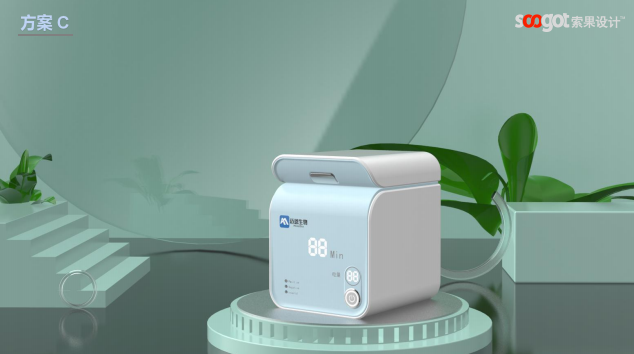
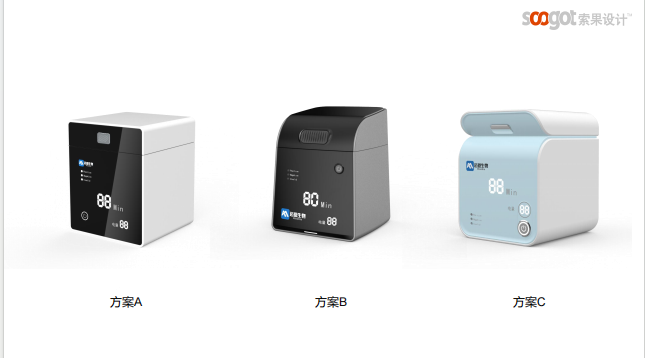
These are three small nucleic acid detector schemes (A-C) designed and built by Suoguo. As a rapid detection equipment suitable for small medical scenes, its design revolves around "portable mobility rapid detection efficiency" and realizes accurate adaptation of grass-roots/emergency detection scenes in compact form, functional layout and details. It is a design sample integrating "compact function" and "scene friendliness" of small medical equipment.
1. Design Analysis: Compacted Functionality for Small Inspection Scenarios
The core scenarios of the small nucleic acid detector are grass-roots clinics, community convenience points, emergency mobile detection, and the design of the underlying logic to "compact function portable mobile" as the core:
The functional modules are highly integrated: the three schemes compress the "detection core area (built-in reagent/sensor), interactive display area (small screen key parameters) and sample processing area (single sample tank)" into a compact cube form, which is suitable for the small scene requirements of "single sample rapid detection"-without complex operation of large equipment, medical care can quickly complete the process of "sample placement → startup → reading results, in line with the" efficient flow "needs of the grass-roots/emergency scenario.
Scenario expression of materials: the combination of "medical-grade lightweight plastic scratch-resistant panel" is adopted, the lightweight plastic ensures the portability of the equipment (it is convenient for doctors and nurses to carry it to different detection points), the scratch-resistant panel meets the wear-resistant requirements of high-frequency secondary use, and the white/light blue substrate transmits the medical attributes of "sterility and safety", which meets the health standards of nucleic acid detection.
2. Design Language: Simple Scene Aesthetics of Small Medical Equipment
The design language of the three schemes is based on "compact and simple scene adaptation", which adapts to different small scenes through color and shape differences:
Common: compact tool aesthetics: all adopt the form of "small cube without redundant decoration", weaken the bulkiness of large medical equipment, convey the attribute of "light weight and easy to use", and adapt to the space limitation of small scenes (such as clinic desktop and emergency kit).
Difference: Scenario Style:
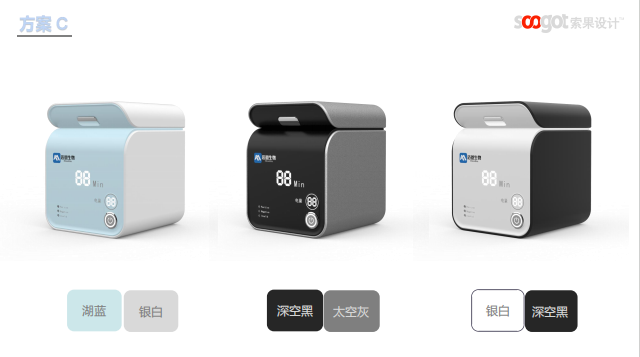
Scheme A (black-and-white color contrast): strengthen the "sense of professional tools" with black-and-white contrast, adapt to the "medical professional" scene of primary clinics, and let doctors and nurses quickly perceive the reliability of the equipment;
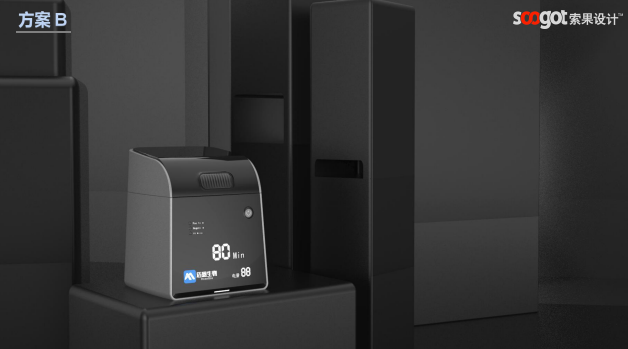
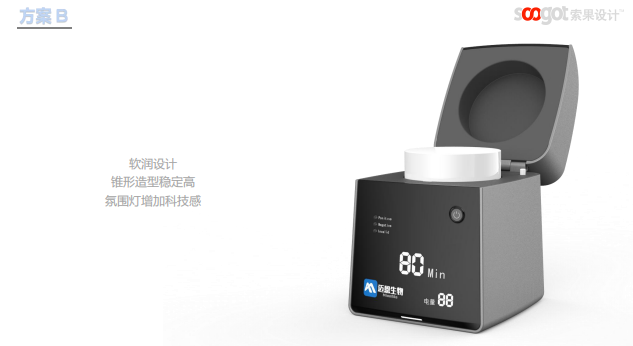
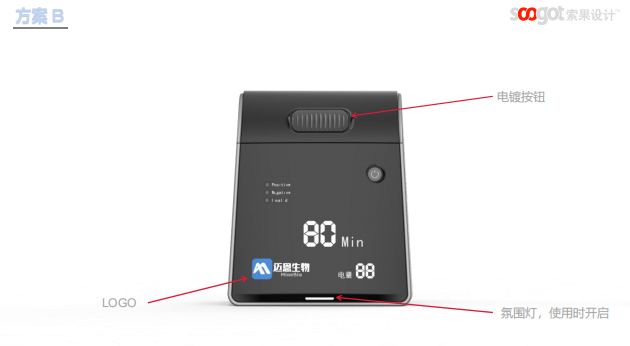
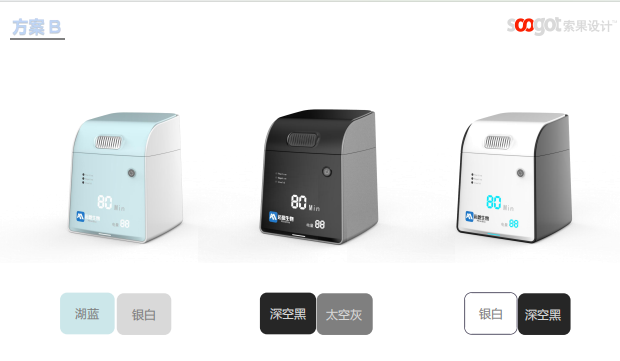
Scheme B (dark gray low-key): the dark gray base is used to transmit a "sense of stability and reliability", which is adapted to the "low-key and efficient" scene of emergency mobile detection and reduces visual interference in the environment;
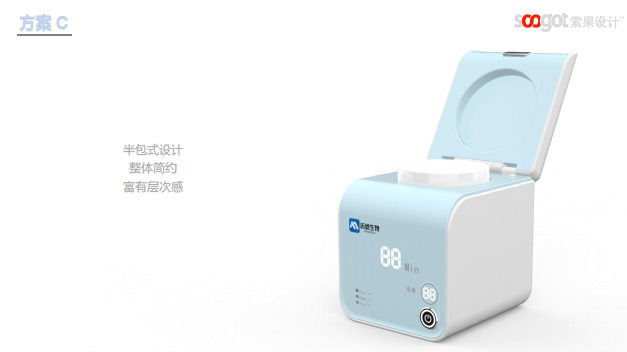
Scheme C (light blue soft): transmit "affinity and friendship" with light blue base, adapt to the "public contact" scene of community convenience, and relieve the tension of ordinary subjects.
3. Design Details: Implicit Efficiency Support for Rapid Detection
The detailed design revolves around "quick detection of pain points in small scenes:
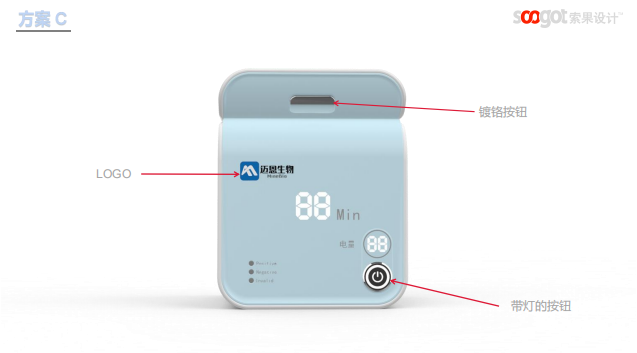
Details of the interactive area: all adopt "small-size high-definition screen to streamline parameter display" and only display core information such as "detection progress, result value" to avoid redundant data from interfering with rapid decision-making; The keys of some schemes (such as scheme c) adopt "raised large keys" to meet the requirements of medical care wearing gloves and improve the operation efficiency of the detection process.
Details of the sample area: the sample tank adopts a "dumb-proof single-tank design", which can only be inserted into the sampling tube in one direction, thus avoiding the problem of misplacement of samples in small scenes (operated by a single doctor); The joint between the sample tank and the fuselage is "inclined chamfered" to facilitate the rapid taking and placing of the sampling tube and meet the needs of high-frequency circulation of single sample.
Portable details: the size of the body is controlled within the range of "one-hand grip" (inferred from the proportion), and the top/side of some schemes are reserved with "portable holding area", which is convenient for doctors and nurses to carry to different detection points and adapt to the "rapid deployment" requirements of emergency mobile scenarios.
4. ergonomics: comfortable adaptation of small scenes
The ergonomic design of the three schemes is optimized for "single-person operation in small scenes:
Operation posture adaptation: the height of the fuselage conforms to the natural height of the elbow of the "desktop sitting posture operation", and the doctor can complete sample picking and placing and parameter viewing without bending down, thus reducing muscle fatigue in small scenes (long-term single duty);
Operation process adaptation: the layout of the sample tank and interaction area follows the "natural extension range of the arm". When the doctor operates alone, the doctor can smoothly complete the action of "taking the sampling tube → placing the sample → operating the equipment" without moving the body greatly, thus improving the continuity of the detection process;
Portable operation adaptation: the weight of the fuselage is controlled within the range of "light weight and no burden", which is suitable for the demand of "one-handed transportation and rapid deployment" of medical care. Even in emergency scenarios (such as outdoor temporary detection points), the placement and debugging of equipment can be quickly completed.
Conclusion: Portable Efficiency Partner for Small Nucleic Acid Detection
The design of these three small nucleic acid detectors is a symbiotic sample of "compact function" and "scene experience" of small medical equipment. It takes functional integration as the skeleton and adapts to the space and efficiency requirements of small scenes. With simple scene aesthetics as the texture, the equipment is compatible with the atmosphere of different small scenes. Taking detail design as the nerve, it supports the efficiency and safety of rapid detection. Taking ergonomics as the blood vessel, it is suitable for comfort and portability of single operation.
With the growing demand for primary care and emergency testing, this design not only improves the efficiency of nucleic acid detection in small scenes, but also redefines the value of "small medical equipment"-it is no longer a "reduced version" of large equipment, but a "portable efficiency partner" customized for small scenes ". This concept of "driving function optimization with scene compactness" also points out the direction for the design of small medical equipment: only by focusing on the real pain points of small scenes can we create truly practical lightweight medical products. Sogo Design: www.soogot.com



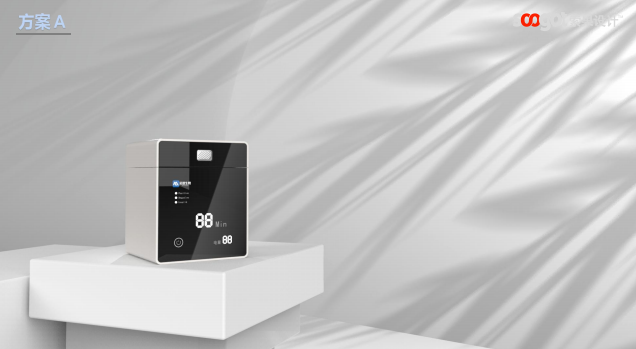
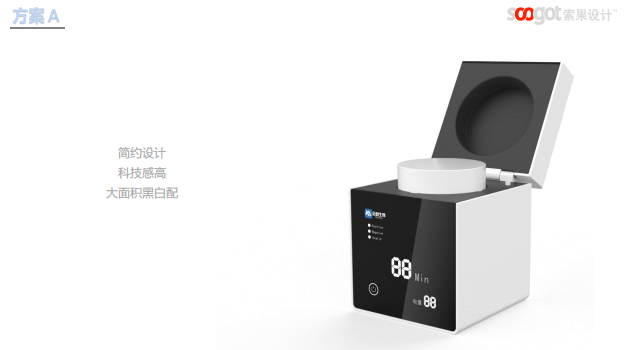
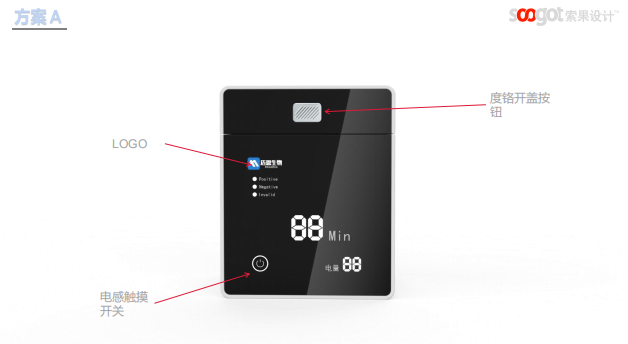
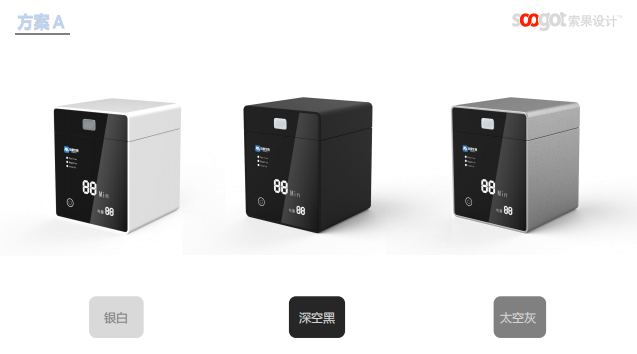




I quite like Scheme A. It is made like a consumer electronic product with simple shape and advanced color matching.
Professional Medical Equipment
That's very thoughtful.
Small size does not take up space, ha