Sogo Design... Ten years of focus on medical health the only track.
Cooperative customers: well-known confidential customers
project name: medical device ui design
Cooperation content: design analysis | appearance design | structural design | prototype production | accompanying running assistance
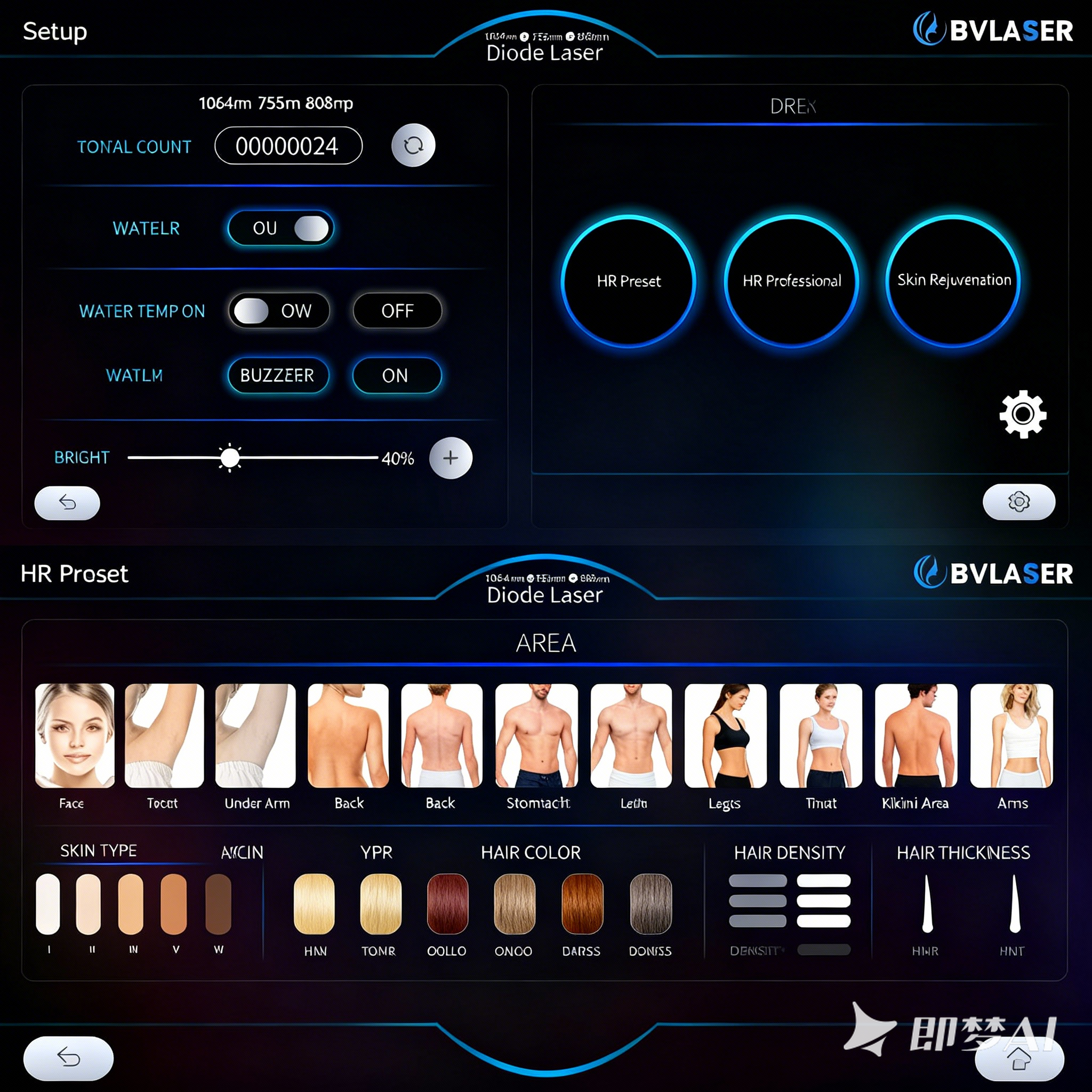
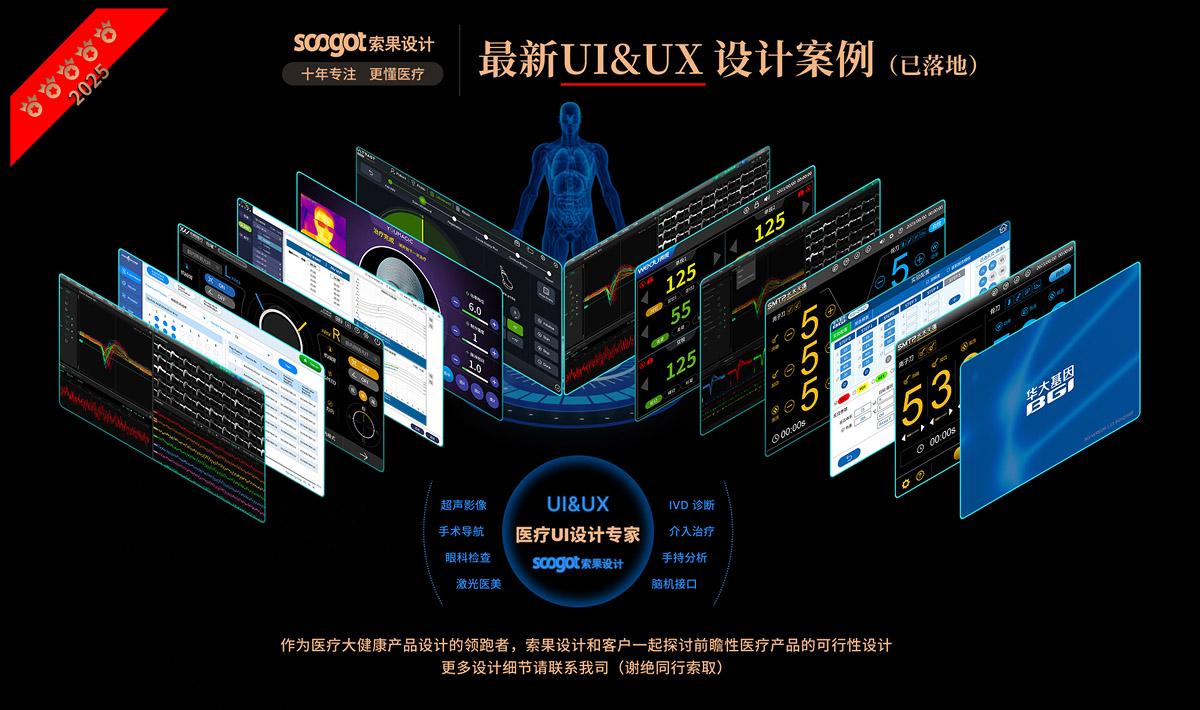
This is the UI interface design of medical devices BVLASER diode laser equipment, covering core scenes such as equipment setting, treatment mode operation, abnormal warning, etc. As the operation terminal of medical/medical beauty laser treatment, its design focuses on "the precision of medical care operation and the safety of treatment process", and deeply adapts to the requirements of medical scenes in interface layout, interaction logic and visual details, it is a design sample of the integration of "functional rationality" and "operation-friendly" of medical device UI.
1. Design Analysis: Process-based Functional Adaptation of Medical Scenarios
The core service scenario of the UI interface is the laser treatment (such as hair removal and skin rejuvenation) of medical beauty/medical institutions. The underlying logic of the design is based on the "priority of the treatment process" as the core:
The process disassembly of the functional module: the interface is divided into four modules: "equipment setting area (water temperature, brightness adjustment), treatment mode area (HR Preset/Professional, Skin Rejuvenation), parameter adjustment area (frequency, pulse width, etc.), and state early warning area (abnormal prompt)", which accurately adapts the complete treatment process of "preoperative equipment debugging → selection of treatment items → intraoperative parameter fine adjustment → abnormal emergency treatment. The modular layout without redundant functions avoids the interference of irrelevant information in the treatment of doctors and nurses, and ensures the concentration of operation.
The medical attribute adaptation of the scene: laser treatment requires extremely high parameter accuracy and operational safety, and the interface function not only covers the personalized treatment requirements of "patient skin/hair attribute matching", but also strengthens the safety requirements of "equipment status monitoring and abnormal early warning", which is in line with the double standard of "precision and safety" of medical operation.
2. Design Language: Rational Visual Expression of Medical Technology
The interface adopts the design language of "dark base neon light effect", which not only conforms to the professional attribute of medical scene, but also optimizes the operation experience:
Scene adaptation of the dark base: the medical beauty/treatment clinic is often in a low-light environment, and the dark background effectively reduces the reflection of the screen to ensure that the medical staff can clearly read the parameters in the treatment; at the same time, the dark tone of low saturation conveys the "calm, professional" medical equipment attributes to avoid visual stimulation interfering with the treatment rhythm.
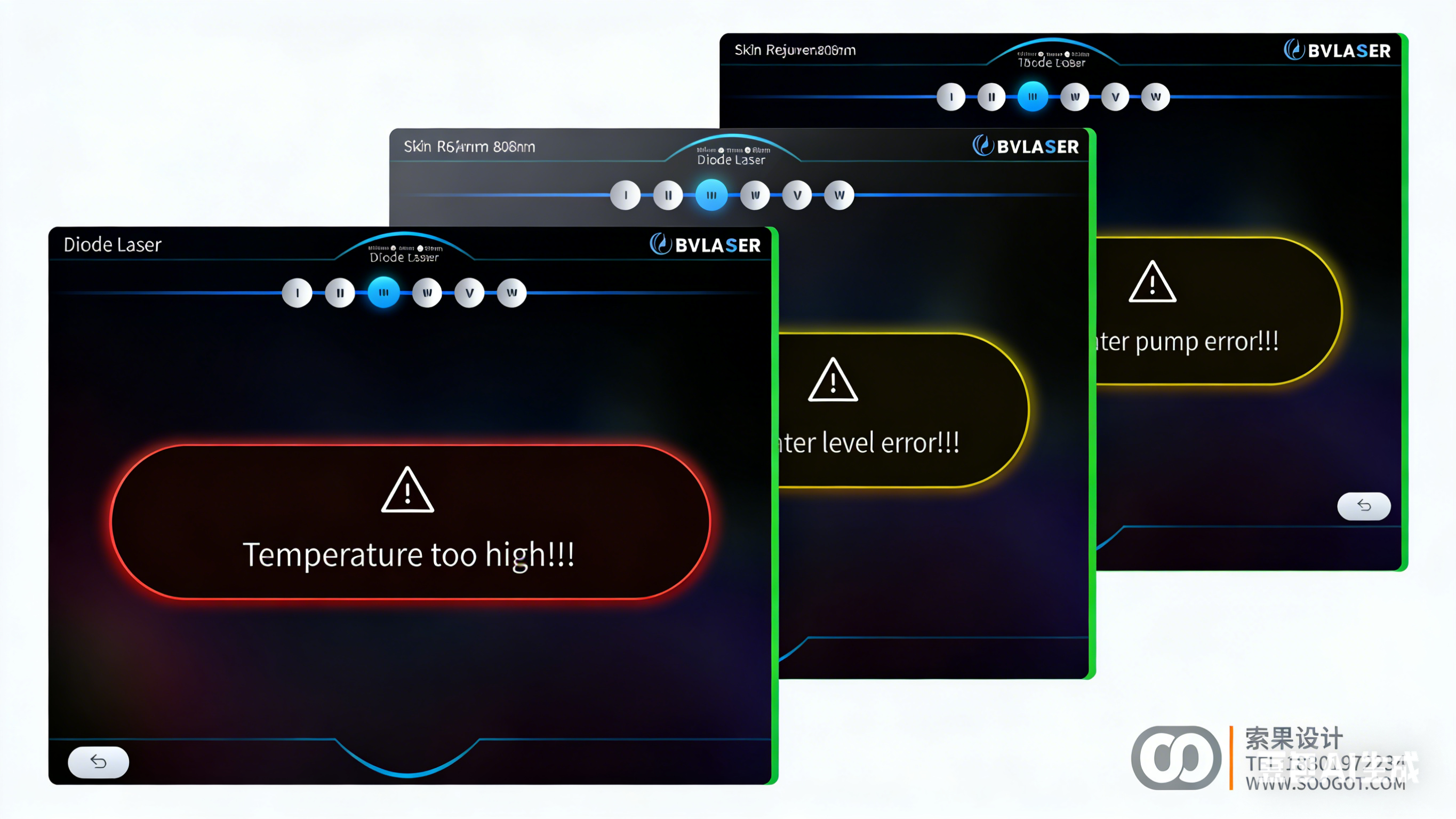
Functional identification of neon lighting effect: color is used to distinguish functional priority-blue corresponds to the normal operation area (parameter adjustment and mode switching) to strengthen the identification of interactive area; Green is the exclusive identification of "skin rejuvenation" mode, matching the "mild care" attribute of the project; Red/yellow is used for abnormal early warning, quickly capturing medical attention with high saturation color, and transmitting the signal of "danger, need to be dealt with immediately.
3. design details: precise support for medical operations
The detailed design revolves around the "low error rate of medical operations" to accurately solve the pain points of the treatment scenario:
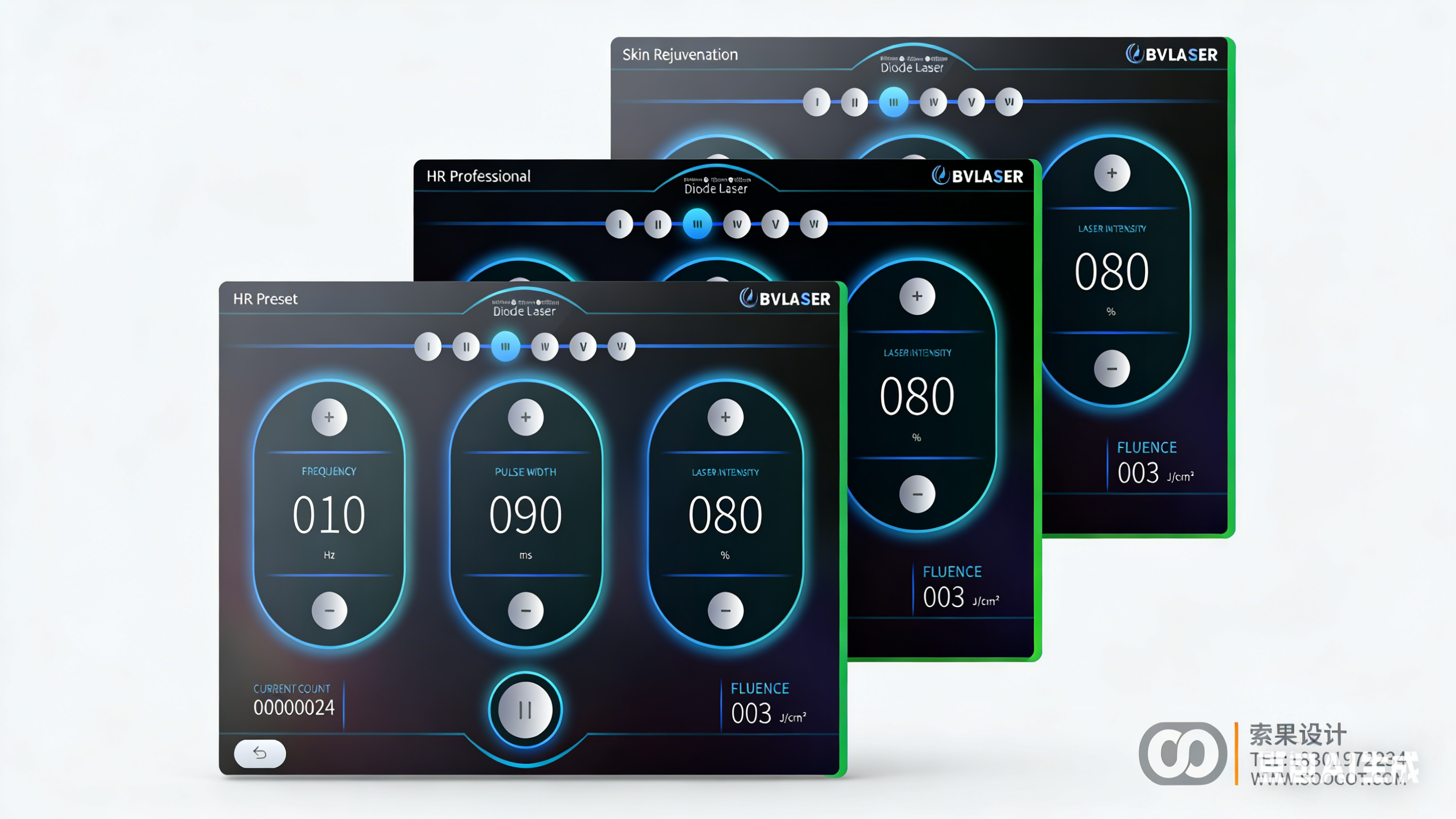
The intuitiveness of parameter interaction: the parameter adjustment area adopts the "large number display independent addition and subtraction button", the font size is enlarged to the visual focus level, and the doctor can read the value without approaching; The button size meets the requirements of "wearing medical gloves for operation" (≥ 10mm touch safety size) to avoid accidental touch caused by glove obstruction during treatment.
Visualization of the treatment scene: The "AREA" interface presents the treatment area with human body part icons instead of text descriptions, reducing the cognitive cost of medical care; options such as skin type and hair attributes are presented with "color block minimalist identification" to visually match the individual patient's situation and reduce the probability of error in parameter matching.
Strong prompt of abnormal early warning: the error interface adopts the combination of "high saturation color amplification text of warning icon"-red corresponds to the emergency fault of "high temperature" and yellow corresponds to the secondary early warning of "water pump/water level abnormality". the difference between color and visual level enables doctors and nurses to quickly distinguish the fault level in treatment and improve the emergency treatment efficiency.
4. Ergonomics: Visual and Action Adaptation for Medical Operations
Starting from the operating habits and visual logic of medical care, optimize the human-computer interaction experience:
Focus adaptation at the visual level: the core parameters (frequency, laser intensity) are placed in the line of sight focus area in the middle of the interface, and the state information (treatment count, energy density) is distributed at the corners but kept clearly distinguishable, avoiding frequent movement of the line of sight of doctors and nurses and reducing neck fatigue.
Process adaptation of operation logic: mode switching adopts "tab layout", which is completely consistent with the treatment logic of "selecting treatment items → adjusting corresponding parameters", reducing the jump of operation steps; General operation buttons such as return and confirmation are fixed at the corners of the interface to form muscle memory operation habits.
Action adaptation of the touch area: the spacing of all interactive elements is ≥ 5mm, so as to avoid "accidental contact" when wearing gloves; The positions of common operation buttons (such as parameter addition and subtraction) match the natural extension range of fingers, and the operation can be completed without deliberately adjusting the holding posture.
Conclusion: The balance between function and security of medical UI
The UI interface design of this medical device is a symbiotic sample of "scene adaptation" and "experience optimization" of medical device operation terminal. It takes the treatment process as the skeleton to disassemble the functional module, transmits professional and safety attributes with color light efficiency, supports accurate operation with detailed design, and adapts the operation habits of medical care with ergonomics-realizing a two-way balance between function and experience between the rigor of medical treatment and the convenience of operation.
With the increasingly refined operation of medical equipment, such UI design not only improves the efficiency and safety of laser treatment, but also redefines the value of "medical equipment UI": it is no longer a cold functional carrier, but a "safe partner" in medical treatment ". Sogo Design: www.soogot.com







GOOD JOB
This is really good
High-tech